
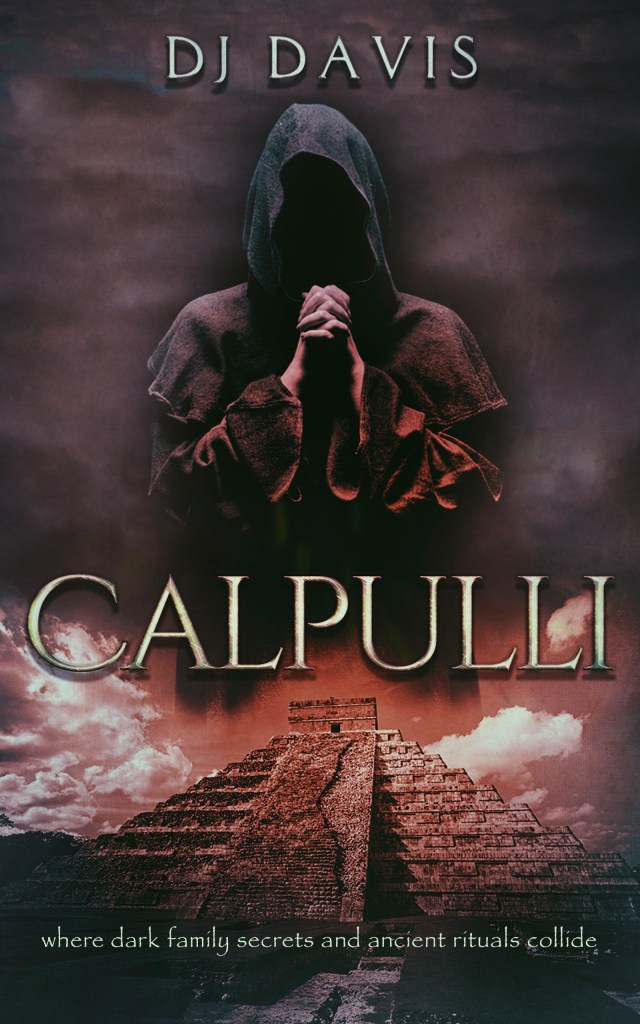
Mitchell Faulconbridge was born to be sacrificed.
Available in ebook, audiobook, paperback, and hardcover editions.
In a world where ancient gods demand blood and secrets lurk in every shadow, Mitchell—a reserved landscaper haunted by a brutal past—sees his quiet existence shattered when a ruthless Aztec goddess, Tlazolteotl, resurfaces to claim her due.
He is dragged back to the shadowed commune of Calpulli and the horrific memories of his childhood, where the boundaries between myth and reality blur.
Mitchell finds himself facing impossible choices: protect his fractured family and his own soul from a deadly curse, or surrender to a destiny steeped in sacrifice and sin. With his every step echoing with the threat of betrayal and supernatural terror, the only question that remains is where does darkness end and redemption begin?
5.0 out of 5 stars Page-turner, nonstop intensity – Amazon Customer
This turned out to be one of those books I just could not put down. The story itself is based on past real history with an Aztec goddess and a fictional cult following with a group of people, although her fiction is something that could certainly happen in present times, which makes it that much creepier. I can see myself reading this again and again.
The Truth Behind The Fiction
A few notes about Calpulli. First, I took some liberties with the Nahuatl language, the Aztec religion, and the southeastern corner of Arizona — but only minor ones I hope.
Cedar Spring, Granger, and Calpulli are all fictitious locations, but the Chiricahua Mountains in southeast Arizona are very real and very beautiful. I’m sure it pained Geronimo deeply leave them behind when he surrendered his freedom.
If you should go there take a map and a lot of water. And if a lonely goddess whispers to you from the canyons, and calls you Tlapepentli, get out of there.
The Goddess
Tlazolteotl [tɬasoɬˈteotɬ] was a primary Aztec deity. The name comes from the Nahuatl words tlazolli, for garbage, and teotl, for deity. It is thought she originated in the region of the Huastec peoples bordering the Gulf of Mexico. As her name suggests, Tlazolteotl was goddess of filth, which is illustrated by her four life stages. The first as a young temptress. The second was associated with gambling. The third with the power to forgive sins. The fourth as a hag who misled youths.
Dirt symbolized sins and Tlazolteotl was usually depicted with dirt around her mouth. She ingested the dirt—sins—to purify it.
Tlazolteotl was celebrated during the festival of Ochpaniztli which was held in the first half of September to recognize the harvest season. The ceremonies conducted during this festival included ritual cleaning, sweeping, and repairing, as well as dances and military ceremonies.
The Aztec religion offered a formal, once in a lifetime confession of sins. The exact date of the confession was established by a priest, usually during the Festival of Ochpaniztli.
Human Sacrifice
Although the exact figures are unknown, human sacrifice was rampant throughout the Aztec empire due to the belief that continued sacrifices to the gods sustained the Universe.
Each sacrifice was planned according to the ceremony required by a particular god or goddess. The most popular form of human sacrifice was heart-extraction. Five priests performed the sacrifice, usually on top of a temple. The victim was laid on a table and held down. A cut was made in the abdomen and through the diaphragm. The priest would remove the heart and place it in a vessel of the honored god. The body was thrown down the temple’s steps.
The viscera was fed to the zoo animals and the head was placed on display in a skull rack. When cannibalism was involved, the warrior who captured the victim was given the meaty parts.
Other types of sacrifice included being shot with arrows, burning, flaying, and drowning.
Sacrificing animals was common practice, including jaguars, dogs, eagles, hummingbirds, and butterflies.
As with most things, there were many more facets to the goddess and the worship of her than I have included here.
Reviews Matter. If you’ve read one of my books, an honest review helps me keep writing more of the stories you love (even if it’s a simple rating without a comment). Thank you and enjoy the adventure!
For Reviews:
Content Warning:
child abuse, gory violence, profanity
No generative artificial intelligence (AI) was used in the writing of this work.